In late August, a man in Nassau County, up near Jacksonville, got a phone call. The caller told him to buy $14,000 worth of gift cards within two hours, or his account would be hacked. He went to the store.
What saved him was his wife. She called the sheriff's office about the call he was on, and deputies found him in a store parking lot before he had paid the caller a cent.
I want to start there because it shows how these scams really work. Nobody falls for "please send me gift cards." People fall for an emergency, a deadline, and a calm, official-sounding voice. The gift cards come at the very end, and by then the story feels real.
So here is the one rule that cuts through every version of it.
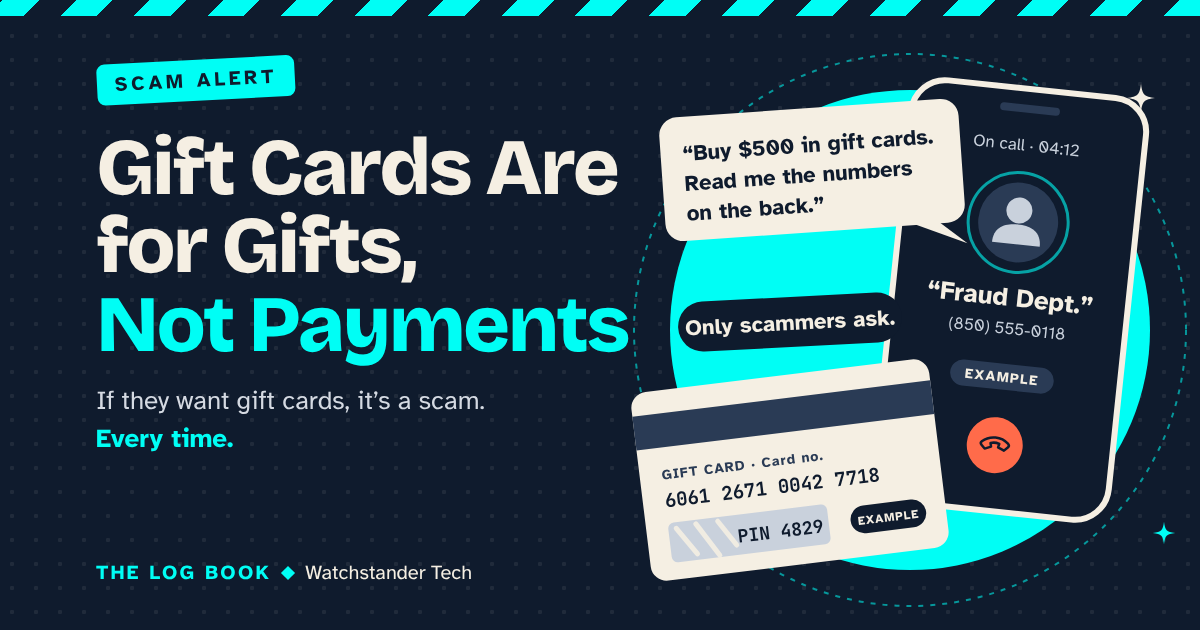
If they want gift cards, it's a scam.
The Federal Trade Commission puts it about as plainly as a government agency ever does: "anyone who insists that you pay by gift card is always a scammer." Our own Bay County Sheriff's Office says the same about its side: "No law enforcement agency will request payment in the form of a gift card."
The FTC says the people demanding gift cards most often pretend to be from the government, a business, tech support, or "a friend or family member in trouble." The costume changes. The payment doesn't. I've written about two of those costumes already: the fake agent in [Yes, That Agent Is Real. The Caller Isn't.](https://logbook.watchstander.tech/yes-that-agent-is-real-the-caller-isnt/) and the fake refund in [The Refund That Wasn't](https://logbook.watchstander.tech/the-refund-that-wasnt/). Both end at the gift card rack.
That's what makes this rule so useful. You don't have to figure out whether the caller is really from the IRS or your bank. The moment the answer is "gift cards," you already know.
Why scammers love them
The FTC has studied this. It found that scammers favor gift cards because they're easy to find and buy, and they have fewer protections for buyers than other ways to pay. In the agency's words, "Scammers can get quick cash, the transaction is largely irreversible, and they can remain anonymous."
Here's the part that surprises people: the scammer never needs the card itself. The FTC explains that the card number and PIN on the back let the scammer get the money you loaded onto it. So they ask you to read the numbers over the phone or send a photo of the back. The card stays in your hand. The money is gone in minutes.
They also script the shopping trip. According to the FTC, scammers often tell you which card to buy and which store to visit, may keep you on the phone while you pay, and sometimes have you spread purchases across several stores "so cashiers won't get suspicious." If someone on the phone is directing your errands, that alone is a red flag.
A second trick: cards drained before you buy them
Gift cards are also a real present, and this time of year a lot of us buy them. There's a quieter scam aimed at those shoppers. The FTC warns that scammers can get a card's number and PIN before you ever buy it, then wait for you to load money onto it. Officials in Los Angeles County have described thieves sticking their own barcode over an unsold card on the rack, so the money you load goes to them.
Before you buy, look the card over. If the back looks scratched or a sticker has been removed, tell a cashier or manager, and the FTC suggests trying a different store. Keep copies of the card and the receipt.
What to do
1. Stop when you hear "gift card." Hang up or close the message. Then, if you're worried, call the agency, bank, or relative yourself on a number you already trust.
2. Never read the numbers on the back to anyone, or send a photo of them. Those numbers are the money.
3. If you already paid, call the gift card company right away. Please let them know the card was used in a scam and request a refund. The FTC notes some companies may return it. Keep the card and the receipt, then report it at ReportFraud.ftc.gov.
4. Check cards before you buy them as gifts. Please return scratched backs, missing stickers, or torn packages to the cashier.
For families: the Nassau County story is the strongest case for discussing this ahead of time. I agree that no one in the family pays anyone with gift cards, and that a call demanding it is a call to tell someone else about it first.
For small businesses: your cashiers see these purchases in real time. A friendly "Are you buying these for someone on the phone right now?" can stop a loss, and you can post the FTC's rule right by the gift card display.
Gift cards are for birthdays, thank-yous, and stocking stuffers. If anyone wants one as payment, you already have all the information you need about them.
Stay sharp out there.
Andrew
← All posts
Gift Cards Are for Gifts, Not Payments