As I write this on Friday afternoon, Hurricane Isaias is a Category 3 storm closing in on the Florida Panhandle and the Alabama coast, and Bay County is under the governor's state of emergency. By the time you read this, a lot of us will be cutting limbs off roofs, waiting on power, and on hold with insurance companies. I hope you and your people are safe.
I want to talk about what tends to come next, because it comes fast.
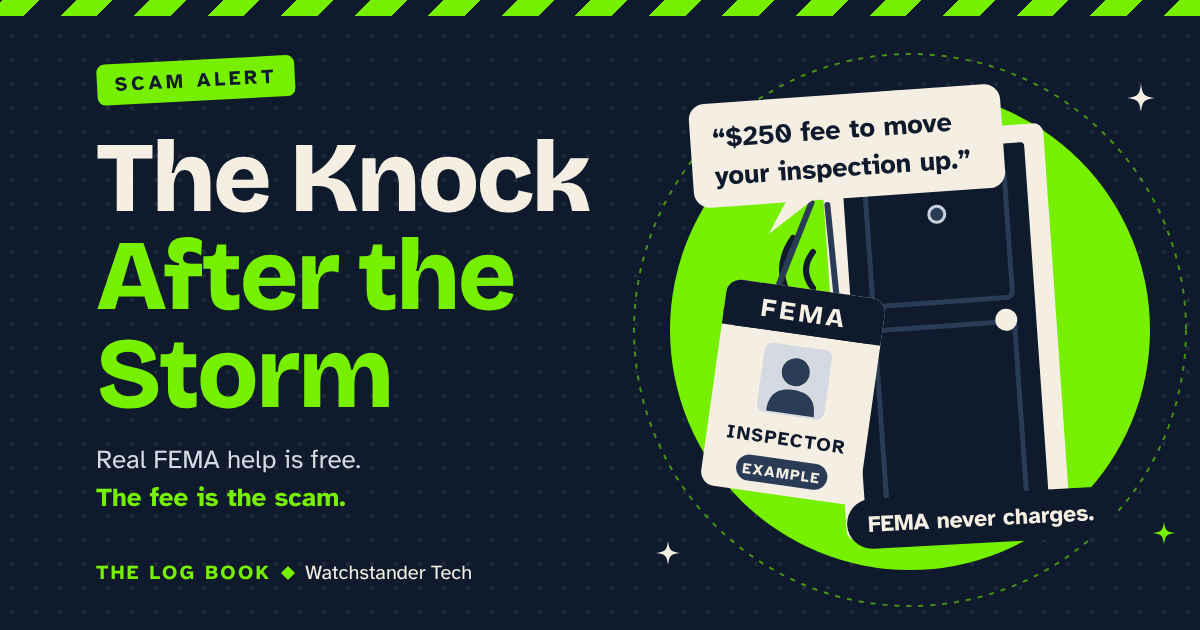
It's the knock at the door. A man in a polo shirt, a badge on a lanyard, a clipboard: "I'm with FEMA. There's a $250 processing fee to move your inspection up." Or a pickup truck with a trailer full of saws: "We can have that tree off your house today. Cash up front so we can buy materials."
This isn't theory here. In September, the U.S. Attorney's Office for the Northern District of Florida, the FBI, and the Bay County Sheriff's Office held a joint briefing about hurricane recovery scams. They described what happened after Hurricane Michael: out-of-state crews without the required licenses or permits charged residents up to $30,000 to clear yard debris. "They will come in with all sorts of fake documents," said Bay County Chief Deputy David Baldwin. The people they named as targets were homeowners with heavy damage, people with insurance claims, and residents waiting on federal disaster money. After a storm, that's a lot of us.
It works because the emergency is real. You're exhausted, the house is open to the weather, and someone is offering to fix it today. The scammer doesn't have to invent the pressure. The storm already did.
The fake FEMA visit
Here's the rule worth taping to the fridge, from the Federal Trade Commission: "FEMA employees will never ask for money for inspections, disaster assistance, debris removal, or grants." And: "If someone asks you for money to help you qualify for FEMA funds, it's a scam."
The FTC also says real FEMA staff and contractors "always wear an official badge with their name and photo on it," and that "FEMA inspectors will not ask for your banking information." But a badge is easy to fake, and the FTC warns that scammers use fake badges and FEMA clothing. So treat the badge as step one, not proof. If you're not sure, close the door and call FEMA yourself at 1-800-621-FEMA (3362).
If the knock comes as a phone call that shows a government name, the same rule applies. I wrote about caller ID spoofing in "Yes, That Agent Is Real." The Caller Isn't.: hang up and call the agency on a number you look up yourself.
The storm-chasing crew
A "storm chaser" is a crew that follows hurricanes from town to town, takes deposits, and does poor work or none at all. The FTC's advice is simple: walk away if they demand cash up front, and walk away if they refuse to provide copies of their license, insurance, and a written contract.
In Florida, checking a license takes about a minute. Search the name at MyFloridaLicense.com or in the free DBPR Mobile app from the Department of Business and Professional Regulation. The state takes this seriously: during a declared state of emergency, contracting without a license is a third-degree felony. At the September briefing, officials also suggested looking the business up on Sunbiz.org and confirming permits with the county building department before you sign or pay.
Watch prices, too. Florida Attorney General James Uthmeier activated the state's price gouging hotline ahead of Isaias, and services such as tree removal, water remediation, and roof repairs may be covered. You can report a price that appears to be wrong on the Attorney General's website.
The fake relief fund
When a storm hits home, people want to help. Scammers know it. Officials at that same briefing warned about counterfeit charity websites built to look like real relief organizations. Give to groups you already know, and get there by typing their address yourself, not by tapping a link in a text or a post.
For small businesses
The same crews knock on shop doors. Make one simple rule for everyone on staff: nobody pays a contractor until the license is checked and the contract is signed, and nobody pays in cash.
What to do
- Never pay for FEMA help. FEMA doesn't charge for inspections, assistance, debris removal, or grants. Anyone asking for a fee isn't FEMA.
- Check the license first. MyFloridaLicense.com or the DBPR Mobile app, plus a written contract and proof of insurance.
- No cash up front. A crew that needs cash today to "buy materials" is a crew to walk away from.
- Give to charities you already know. Type their address yourself.
If you have already paid or shared information
Call your bank or card company right away. Report disaster fraud to the National Center for Disaster Fraud at 866-720-5721, and to the FTC at ReportFraud.ftc.gov. You can report unlicensed contracting to the DBPR's Unlicensed Activity Hotline at (866) 532-1440. And tell someone. These crews count on people being too embarrassed to speak up, and your report may save your neighbor down the street.
Take care of each other this week.
Stay sharp out there.
Andrew