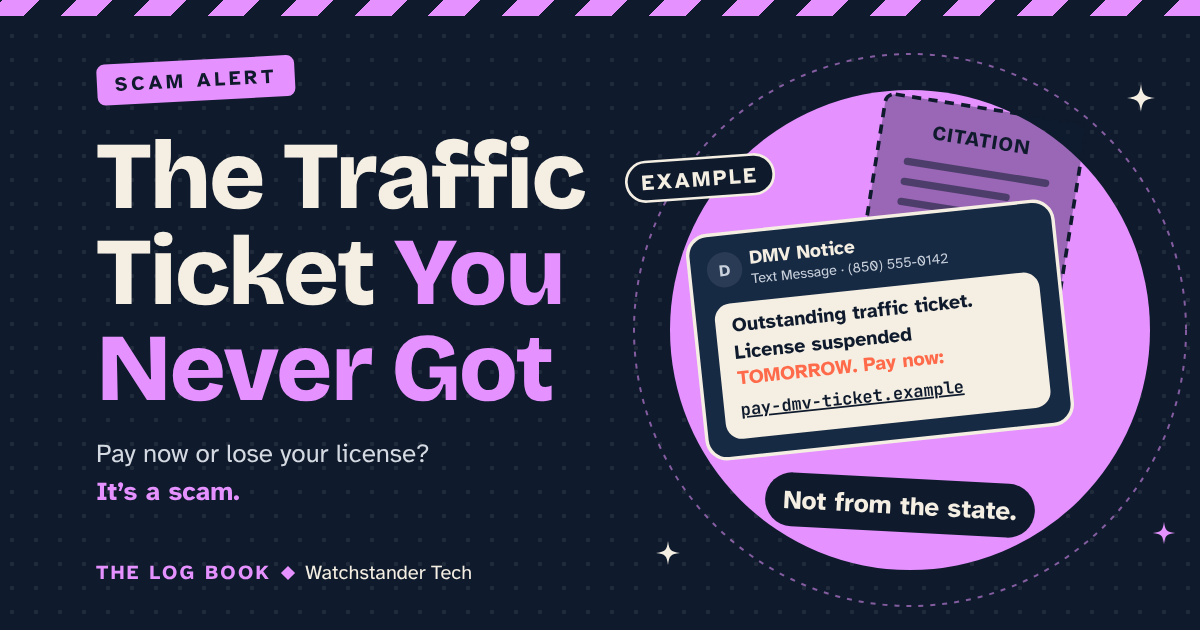
The text usually arrives at a bad moment, when you're busy and not thinking about your driving record at all. It reads something like this: "Our records show that as of today, you still have an outstanding traffic ticket." Then come the threats. Pay through the link by tomorrow, or your driver's license and vehicle registration will be suspended. Some versions pile on more: a big "service fee," collections, damage to your credit.
Your stomach drops. Did I miss something in the mail?
You didn't. This text has been making the rounds across the country, and Florida drivers have been getting it for more than a year.
What Florida's agency actually says
The state agency that handles driver licenses here is the Florida Department of Highway Safety and Motor Vehicles, or FLHSMV. It has issued a clear warning: "FLHSMV will never contact you via text message demanding payment or threatening suspension or arrest." Our own Bay County Tax Collector warned about the same text in July 2025 and put it just as simply: the state would never notify you by text about a problem with your license.
It isn't only Florida. In January 2026, North Carolina's attorney general warned about a new wave of the same texts, and that state's DMV commissioner said, "We will NEVER request payment by text." Virginia's DMV issued its own warning in March. By July 2025, WFTV reported that the FBI had counted 450 complaints about the fake DMV text in Florida alone.
How the trick works
The message is built to get you moving before you start thinking. There's a deadline measured in hours, a punishment that sounds official, and a link that promises to make it all go away.
The fine is often small. WFTV talked with a Florida mom whose daughter panicked and paid about five dollars. That's the clever part: five dollars doesn't feel worth questioning. But the real prize isn't the fine. It's the card number, name, and address you entered on the fake payment page. In that same family's case, a caller posing as a bank representative followed up and asked for account details. The daughter stopped and hung up.
The link itself is dressed up to look official. Scammers use addresses that contain "DMV" or even ".gov" somewhere in them, but the part that actually matters, the very end of the main address, is something else entirely. In North Carolina, the fake site looked government-ish but really ended in ".cc," a country code. (If you want to see how convincing a fake address can get, I wrote about [look-alike web addresses](https://logbook.watchstander.tech/homoglyph-attacks-the-url-that-isnt/) last month.)
The giveaways
You don't need sharp eyes to catch this one. A few facts do the work:
- **Florida doesn't have a "DMV." **** Our agency is FLHSMV. A text that says "DMV" is already off.
- **Traffic tickets aren't paid to the license agency.** In Florida, you pay a ticket to the Clerk of Court in the county where it was written. Flagler County's clerk, for example, only takes payment for tickets issued in Flagler County.
- **The penalties don't add up.** North Carolina's attorney general pointed out that the texts list penalties that don't exist, like a 35% "toll booth" fee and credit damage from the DMV.
- **Real agencies don't send pay-now links by text. **** That's the whole point of FLHSMV's warning.
What to do if you get one
1. Don't tap the link and don't reply. Not in any way, not even "STOP."
2. Check on your own if you're worried. If you think you really might have a ticket, look up your county Clerk of Court yourself, or type flhsmv.gov into your browser. Don't use anything from the text.
3. Report it, then delete it. Forward the text to 7726 (that spells SPAM), so your carrier can block it; use "Report junk" in your messaging app; and report it to the FTC at ReportFraud.ftc.gov.
4. If you already paid, act today. Call your card company or bank using the number on the back of your card and ask for your money back. If you gave your Social Security number, go to IdentityTheft.gov. And treat any "bank" call that follows with suspicion: hang up and call the number on your card. (Here's [why that caller ID can't be trusted](https://logbook.watchstander.tech/yes-that-agent-is-real-the-caller-isnt/).)
For families and small businesses
If you have a new driver in the house, have this conversation now. Teenagers and young adults are exactly the people who'll panic about a ticket and quietly pay a few dollars to make it go away. Let them know they can come to you first, no lecture.
For parents and grandparents who don't drive much anymore, the text can still land. Remind them that a real problem with a license or a ticket won't arrive as a text with a payment link.
If your business has employees who drive company vehicles, put one line in your next team message: any text about a ticket or a suspended registration goes to you, unopened, not to a payment page.
The scammers are counting on a few seconds of worry. Take those seconds back. Put the phone down, check on your own, and let the link sit there unanswered.
Stay sharp out there.
Andrew
← All posts
The Traffic Ticket You Never Got