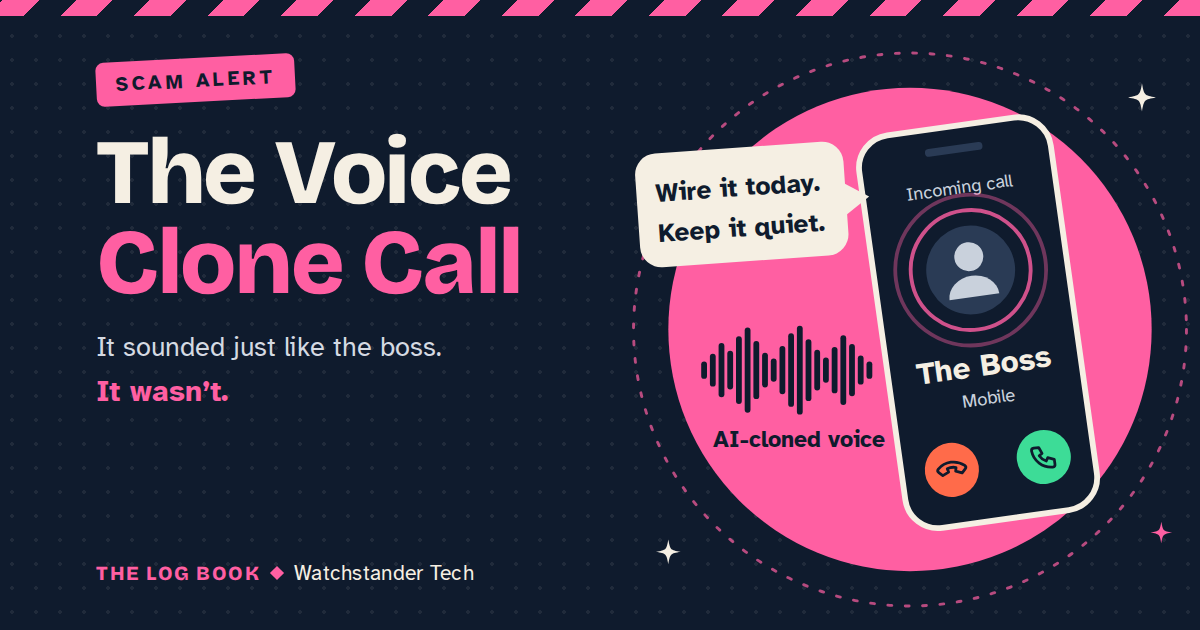
I got a call a few months back from a friend who does IT for a small logistics company here in Bay County. Someone claiming to be his boss called the bookkeeper, sounding exactly like him — same voice, same way he says "hey, quick favor" — asking her to wire money to a new vendor account right away. She almost did it. It wasn't him. It was a recording of him, rebuilt by software, from a few seconds of his voice pulled off a company video posted online.
That's the shape of a scam that's spread fast this year: AI voice cloning. It's the same "grandkid in trouble" call people have gotten for decades, and the same "urgent wire transfer" call businesses have fielded for years — except now the voice on the other end can sound exactly like someone you know, because in a real sense, it is their voice. Just not them saying it.
What's happening
Voice cloning is technology that lets a computer program learn the sound of a specific person's voice — their pitch, pace, and accent — from a short recording, and then generate new sentences in that same voice, saying things the real person never said. A few years ago this took a professional studio and a full script. Today it can be done with a free app and somewhere between three and thirty seconds of audio, which is roughly the length of a voicemail greeting, a short video, or a clip from a company meeting posted online.
The FBI has linked this technique to a wave of "family emergency" calls, where a voice that sounds exactly like a grandchild, a spouse, or a child claims to be in jail, in a car accident, or being held for ransom, and begs for money right now. One grandmother described hearing what sounded exactly like her daughter's voice pleading for help before wiring $5,000. The FBI has tied more than $893 million in losses last year to AI-enhanced scams of this kind. The same trick works on businesses: a voice that sounds like a boss or a vendor calls or leaves a voicemail authorizing an urgent payment, and an employee who has no reason to doubt their own boss's voice sends the money.
How it works
- The scammer finds a short public recording of someone's voice: a social media video, a voicemail greeting, a webinar recording, a company meeting posted online.
- Voice-cloning software builds a model of that voice from the sample.
- The scammer calls a family member, an employee, or a bookkeeper, and the cloned voice says whatever the scammer types: a kidnapping, an arrest, a car accident, a wire transfer request.
- Panic and urgency do the rest. The scammer pushes for wire transfers, gift cards, or cryptocurrency — payment methods that can't be clawed back — and insists it has to happen in the next few minutes.
The red flags
Unusual pauses, an odd rhythm, or background audio that doesn't quite fit are common tells, but don't count on catching those by ear alone — the technology is good and getting better. The more reliable signs are in the setup, not the voice itself: a call that demands secrecy ("don't tell anyone, don't call anyone else first"), pressure to act in the next few minutes, and a request for money that can't be traced or reversed. Any one of those three, regardless of whose voice you think you're hearing, is a reason to stop.
What to do
The fix here isn't training your ear — it's changing your habit. Before you act on an urgent call from someone you know, hang up and call that person back on a number you already have saved, not a number the caller gives you. If you can't reach them directly, try another family member, a coworker, or their employer.
For families, agree on a simple code word ahead of time — something only your real family would know, that nobody would find posted online. If the "emergency" call doesn't include it, or the caller can't produce it, that's your answer. Keep it low-tech and just between the people who need it.
For small businesses, put a second-channel rule in place for any payment request that arrives by phone or voicemail, no matter who it sounds like it's from: no wire goes out, no vendor account changes, without a callback to a known number or confirmation through a separate channel, like email to an address you already have on file. Make sure the rule applies even when the "boss" on the phone is pushing back on it — especially then.
Bottom line
A voice you recognized used to be good enough proof that you were talking to the right person. It isn't anymore. The habit that still works, for a family or a company, is the same one: hang up, call back on a number you already trust, and let money move only after that second check — no matter how convincing the voice on the first call sounded.
Stay sharp out there. Andrew