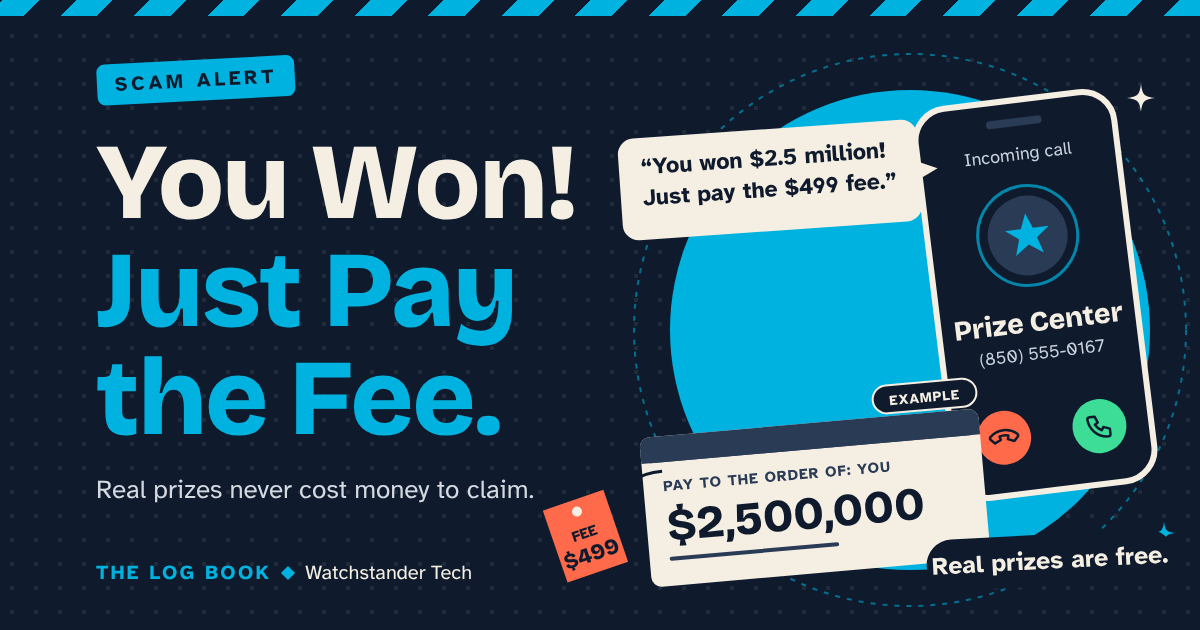
Everybody has daydreamed about it. The phone rings, and a cheerful voice says you've won: a few million dollars, a new car, a sweepstakes you half remember entering. There's just one small thing before they can deliver it. The taxes. Or a processing fee. Or shipping.
That small thing is the whole scam.
The one rule
The Federal Trade Commission puts it in a single sentence: "If you have to pay to get your prize, it's a scam." Real prizes don't come with fees for taxes, shipping, or processing. Real sweepstakes are free, and winning is by chance.
Hold on to that rule, and you can ignore everything else the caller says, no matter how official it sounds.
The Florida Lottery says the same about its own games. In June 2025, it warned that it "will never notify winners by phone, text, or social media," and that it "does not charge fees to claim prizes." Real Florida Lottery prizes are claimed in person at a Lottery office or by mail, with a valid winning ticket.
Scammers also love borrowing the name of Publishers Clearing House. PCH says it never asks winners to send or wire money for any reason, including taxes, and it doesn't call ahead: its Prize Patrol shows up in person for big winners, with no advance phone call or email.
How it plays out
It starts with a win you weren't expecting: a call, a letter, a text, a social media message. Sometimes it's a foreign lottery. The FTC points out that it's illegal for U.S. citizens to play a foreign lottery, so a message saying you won one is almost certainly a scam.
Then comes the fee, and the pressure. The FTC says these scammers push you to act right away and often want the money by wire transfer through a company like Western Union or MoneyGram, or via a payment app, cash, gift cards, or cryptocurrency. Those are hard to trace and hard to reverse. Some ask for your bank account, card number, or Social Security number "to deliver the prize." That's another red flag.
And it rarely stops at one fee. Once you pay, there's a new problem that only money can fix.
A few years ago, WPTV reported on a 91-year-old woman in Citrus County who was told she'd won a $10 million prize and a Mercedes, but had to cover the taxes first. Her neighbors estimated she had lost about $150,000 over the course of a year. They didn't give up on her: they called the sheriff's office, the state Attorney General's office and her bank, and one of them now helps screen her mail.
The second wave: "We can get your money back"
People who've already lost money to a prize scam often get a second call. The FTC warned about this again in August 2026: scammers buy lists of past victims, then pose as a government agency, a law firm, or a consumer group, offering to recover lost money or a prize that never came. Their fee might be called a "retainer," a "processing fee," or a "tax." The FTC says real organizations will never charge you to recover a refund.
If you've been hit once, expect this call, and know it's the same scam in a new outfit. (Here's [why a caller who sounds official proves nothing](https://logbook.watchstander.tech/yes-that-agent-is-real-the-caller-isnt/).)
What to do
1. Never pay to claim a prize. Not taxes, not shipping, not a fee by any name.
2. Hang up, and keep your numbers to yourself. No bank account, card, or Social Security number for a "prize."
3. Check on your own. If you really entered a contest, contact that company using a number or website you already trust, never the one in the message.
4. **Report it.** Tell the FTC at ReportFraud.ftc.gov. If it came by mail, the U.S. Postal Inspection Service wants to know. If you've already paid, please act quickly: call your bank or card company right away. The FTC says the sooner you act, the better.
For families and small businesses
If a parent or grandparent enjoys entering sweepstakes, a call like this can sound completely believable. Kindly talk about the one rule ahead of time. Watch for warning signs, like talk of a big win "coming soon," unusual withdrawals, or a pile of "winner" letters, and offer to make the call to the real company together.
If you run a small business, the same rule holds for any "you've won" message to the business: a real prize doesn't come with a bill. Share the rule with whoever answers your phones and opens your mail.
Winning is supposed to cost you nothing. If someone says otherwise, they're selling a dream they don't have.
Stay sharp out there.
Andrew
← All posts
You Won! Just Pay the Fee.